POLAR BEAR
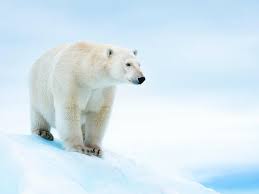
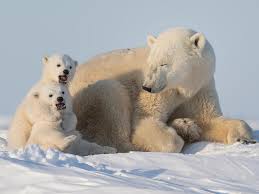
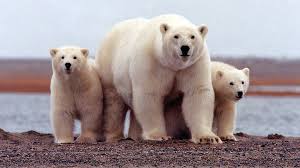
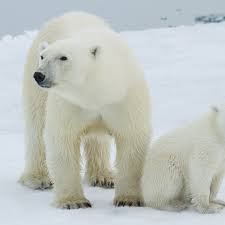
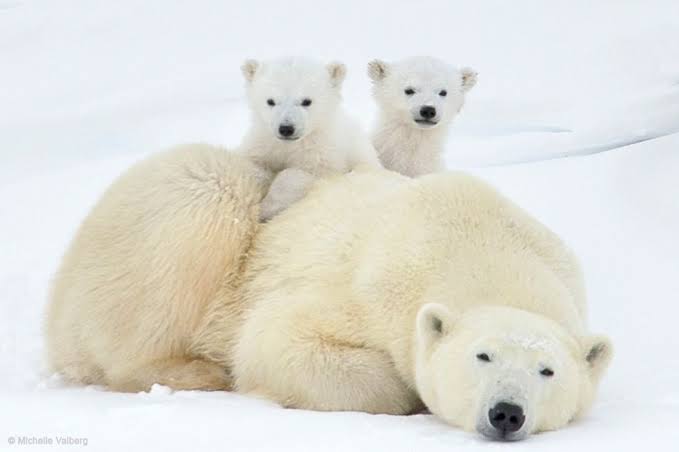
The polar bear (Ursus maritimus) is a hypercarnivorous bear whose native range lies largely within the Arctic Circle, encompassing the Arctic Ocean, its surrounding seas and surrounding land masses. It is the largest extant bear species, as well as the largest extant land carnivore.
Although most polar bears are born on land, they spend most of their time on the sea ice. Their scientific name means "maritime bear" and derives from this fact. Polar bears hunt their preferred food of seals from the edge of sea ice, often living off fat reserves when no sea ice is present. Because of their dependence on the sea ice, polar bears are classified as marine mammals
Because of expected habitat loss caused by climate change, the polar bear is classified as a vulnerable species. For decades, large-scale hunting raised international concern for the future of the species, but populations rebounded after controls and quotas began to take effect.
The polar bear is the most carnivorous member of the bear family, and throughout most of its range, its diet primarily consists of ringed (Pusa hispida) and bearded seals (Erignathus barbatus). The Arctic is home to millions of seals, which become prey when they surface in holes in the ice in order to breathe, or when they haul out on the ice to rest. Polar bears hunt primarily at the interface between ice, water, and air; they only rarely catch seals on land or in open water.
| SPEED : | 40 Km/h (Maximum, Adult, Sprint) |
|---|---|
| HEIGHT : | 1,8 - 2,4 m (Adult, On hind legs) |
| CONSERVATION STATUS : | Vulnerable (Population decreasing) |
| CLASS : | Mammalia |
| KINGDOM : | Animalia |
| FAMILY : | Ursidae |
| MASS : | 450 Kg (Adults, Beaufort Sea population) |
WHERE WILL YOU FIND THEM:
You can find them at pen H44, ice pod zone.
Gallery